
Kathy is one of this site's sponsors
The many faces
of Glastonbury
1. The conventional view of Glastonbury
From what might be thought of as the conventional point of view Glastonbury is a small Somerset market town. A few Bronze Age and Neolithic artifacts have been found on the Tor but we do not have much solid fact about the place before about 600 AD when we learn of a wooden church established in Glastonbury.
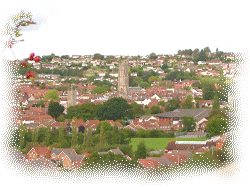
The town as seen from Wearyall Hill
Later in about 950 AD we see written history emerging with St. Dunstan building a new Abbey around the wooden church. By the Middle Ages this had become the great Benedictine Abbey the remains of which can be seen today. Glastonbury was one of the wealthiest Abbeys in the land, its Abbot playing a major part in the ruling of England.
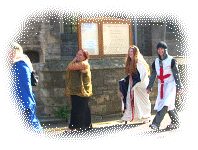
Medieval pilgrims 800 years too late
This great monastery drew pilgrims from afar, kings, princes and ordinary people. These pilgrims found in Glastonbury what they were seeking spiritually and brought with them wealth which was donated to the Abbey. The Abbey grew in strength and prosperity as its possession of lands and property increased. Around this Monastery grew up a thriving town supporting the activities of the monks with local builders, butchers, bakers and merchants and services of every kind.
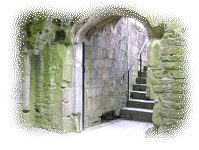
Steps down to the crypt at Glastonbury Abbey
With the dissolution of the monasteries by Henry VIII, the Abbey was closed, the monks were pensioned off and disbursed. Many valuables were taken by the king's men, and the lead was removed from the Abbey roofs and the buildings were left to sink into decay. The town, its main purpose destroyed, sank quietly into its own backwater and faded from the political scene. Some local people felt some relief at this, since the absolute power of the Abbey had kept them as mere servants to the Abbey's monks and visitors – and this feeling survives today in antipathies felt by locals born and bred in Glastonbury toward incomers and their ways.
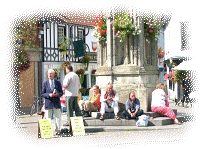
Evangelist converting hippies
at the Market Cross
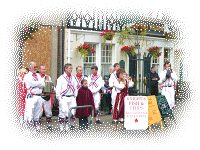
Morris Dancers at the Market Cross
Glastonbury then had to find a new purpose. Over the years it developed into an agriculturally-based market town and more recently a centre for processing sheepskins. Both these activities have now virtually ceased but Glastonbury has begun a new life as a Somerset visitor attraction. A town with unusual shops, where you can find unique items, hang out in cafes, attend events and visit the interesting sites around Glastonbury.
To this town come tourists who look upon Glastonbury simply as another attractive place to visit – no different to Wells or Bath or indeed Clarks Retail Village in the neighbouring small town of Street. Day-visitors stay in the town for a short time and usually visit the Abbey and a few shops. Some visitors do stay a bit longer and are interested in Glastonbury as another small West Country town with attractive surrounding countryside.
This could be said to be the conventional view, but there are other totally different views of Glastonbury.
2. Other views of Glastonbury
As these views are more complex it may be helpful to look at them under a number of headings.
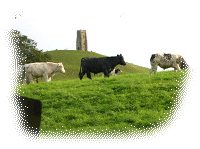
The Tor from Chalice Hill
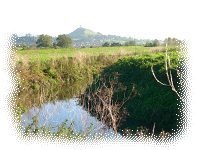
Glastonbury Tor
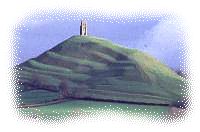
The banks of the Tor
(photo Kevin Redpath)
Geology
The Town is dominated by the Tor, a natural hill, which can be seen for miles around rising out of the flat levels. Some say that the Tor was formed by the waters of what is now Chalice Well. Millions of years ago the iron rich waters of this spring seeping down through the soft sandstone gradually formed a hard dome-like crust. As the softer stone was eroded by wind and water over the millennia the iron hardened stone of the Tor gradually rose above the landscape. In time the low-lying land around the Tor was flooded by the seas leaving what was virtually an island in a marshy inland sea.
The sides of the Tor have been shaped by human hand, with a succession of seven banks encircling it. There's much debate over the dating and purpose of these. Conventional archaeologists call them 'strip lynchets', formed as agricultural terraces during the Middle Ages – though no one has explained why these banks sweep round the northern, sunless side of the Tor, or why such terraces would be needed when there is no shortage of land on the Isle of Avalon. Many people regard the banks as a ceremonial three-dimensional labyrinth built during Megalithic times about four thousand years ago – a plausible, attractive and unproven idea. Some look on these banks as sacredly-intended, perhaps representing seven levels of reality and awareness.

Ancient topography around Avalon
Myths and legends
This island set in its inland sea has been held to be a sacred place for millennia and myths and legends abound. There are the myths of Avalon as a special pagan and Celtic site – a place where long before the Christian era the sacred was worshipped and seen in every spring and stream – in every tree and hill. The home of the bountiful mother goddess. A place where the cycles of the year and its seasons were honoured and celebrated. A place which was one of the great Druid centres of learning.
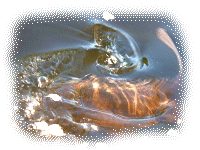
Carp in the Abbot's fish pond
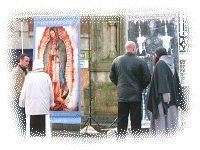
At the annual Catholic Pilgrimage
The Christian legends claim that Jesus' uncle, Joseph of Arimathea, was a metals trader and on one of his voyages to the important lead mines of the Mendip Hills he called in at the port of Glastonbury. He brought with him his young nephew Jesus and they stayed for a while. Some legends say that there was more than one visit and that Jesus built the first simple Church in Glastonbury with his own hands. Other legends claim that Jesus came to learn from the Celtic Druid priests of the mystery school on the island.
After the crucifixion, Joseph is said to have returned to Glastonbury (around either 37 or 64 AD) with a small band of disciples and to have settled here establishing the first Christian Church in Britain. He is said to have brought with him the Holy Grail, the cup of the last supper, and to have buried it somewhere on Chalice Hill.
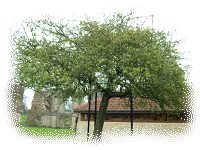
The Holy Thorn, Glastonbury Abbey
The Church that Joseph established grew into the Benedictine Monastery of the Middle Ages. Because of the legends of its beginnings it was held to be the 'England's holiest earth' and was a place of pilgrimage for kings and commoners alike.
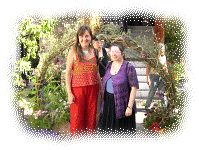
Morgens of the modern time
There are the stories of Glastonbury as the mythical Isle of Avalon, with its links to King Arthur, his knights of the round table and their search for the Holy Grail. Arthur is said to have been brought to Avalon by boat, by the nine faery sisters , the 'Morgens', after his last great battle and to have died on the Island. Even the monks of the Abbey supported this legend claiming to have found in the Abbey grounds the grave of Arthur and his Queen Guinevere.
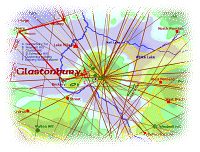
Glastonbury's leylines
(map Palden Jenkins)
Apart from the legends Glastonbury's has retained a reputation as a special earth-sacred site where many leys meet, come together and diverge, connecting with the other power centres of the world.
This entwining of Christian and Pagan myths and legends can be confusing. But whatever beliefs one may hold there is no doubt that many people feel that Glastonbury has very special energies – that it is a notably 'thin' place where the veil between the material and spiritual worlds is tenuous. One effect of this 'thinness' is to amplify the personality traits of all who visit. It is said that one feels more spiritually aware and caring and loving – at the same time ones dark side may also be more pronounced.
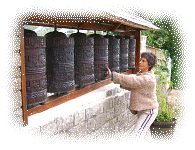
Tibetan prayer wheels on Dod Lane
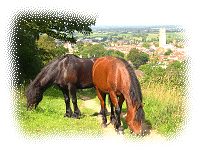
Paradise, top of Dod Lane
Spirituality outside religion
After the First World War disillusion set in and many people lost their faith in established religion. However during the last fifty years there has been a spiritual rather than religious awakening. People are awakening to a need to find a way of contacting the non material world. A need to find a meaning in life other than that of the everyday business of family, working, shopping and having holidays. This awakening has arisen spontaneously in the hearts of many individuals and has not always flowed through the established religious channels.
This extraordinary rekindling of awareness in 'the other' has led to many people seeking their own way of reaching out to the numinous which they sense. This new way of honouring the divine by a spiritual path followed outside any established religion has no generally accepted name. In Glastonbury its followers are thought of as the alternative community.
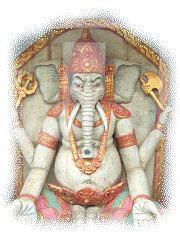
Ganesh in Glastonbury
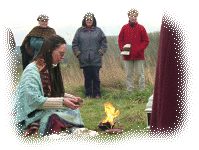
Ceremony at Bride's Mound
One of the key tenets of this new way of thinking and being is that there are many paths that can be followed that lead towards a broader and more spiritual understanding of what it means to be alive – and that each one of these different ways of being has a truth and value of its own. The number of these paths has increased and changed dramatically in the last few years – nonetheless underlying them all can be detected a common theme.
This theme has been called the 'Ancient Wisdom'. The concept is that there are certain ancient spiritual truths that underlie all religions and belief systems. Different people in different places and at different times have found particular beliefs appropriate to their local conditions but they are all reaching out to the same Deity by whatever name it is known.
The Ancient Wisdom holds that there is a spiritual world that is one whole, that cannot be measured by today's science but which is nonetheless real, that each one of us has a spark of this Divine within us and can make direct contact with the Divine. Our life's purpose lies in knowing and understanding that the Divine is the Ground of all being. An awareness of the Divine needs to be present in every aspect of our lives and is not just something we think about in a church on Sundays. It is held that with acceptance of this understanding comes peace, fulfilment and embodiment of the Divine.
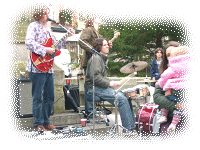
Rocking at the Market Cross
At the turn of the century and again in the 1960s this awakening to spirituality started to gather momentum. A wave of discovery of Eastern teachings was followed by a burgeoning of encounter groups and books on spiritual and ecological subjects. This was the time of Flower Power, hippies, the Beatles and the Maharishi and his teaching on Transcendental Meditation.
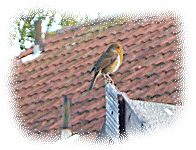
Robin in meditation
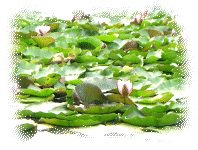
Lilies on the Abbot's fishpond
Today a growing disillusion with the purely material world has lead to the rapid growth in the number of people who want to live in a way that incorporates spirituality in their everyday life. It is a reawakening that has occurred spontaneously to many different people all over the world. It is these pilgrims who are looking to find ways of widening their spiritual experience and who are drawn to places like Glastonbury.
Sacred sites
Hindu philosophy holds that as humans we are beings of mind, body, emotions and spirit, all of which interact and affect each other. A person is only fully healthy if all aspects are in harmony. This body includes seven major chakra points or centres of energy and many smaller centres – all linked by meridians.
The Ancient Wisdom maintains that the earth itself is sacred and is indeed a living being. This ancient belief has recently been revived in the books on the Gaia hypothesis. This view holds that the earth is similar to us in that it has chakra points and linking meridians. These chakra points, where the meridians or energy leys meet, have a very special energy which it is held can be experienced by humans and detected by dowsing.
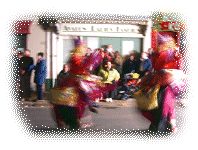
Glastonbury Carnival
We find these energies in many places but where they are particularly strong we frequently find what are known as sacred sites. These are places, such as Avebury , Stonehenge and Glastonbury, where the energies have been honoured and worked with over the centuries. The alternative community would hold that we have a duty to protect and care for these magical places – places in which we can uniquely sense and feel the energies of the earth and the divine essence of which they are a part. Like our own bodies, the earth is only fully healthy if all its aspects are in harmony.
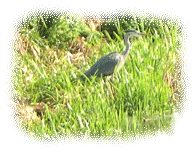
Heron on the Somerset Levels
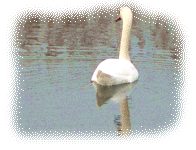
Bride's bird, the swan
Ecology
This new care and respect for the earth leads on to the strong ecological concerns of many people. In Glastonbury there are many initiatives being taken to find ways of living that do not have a long term detrimental effect on the earth. These initiatives are supported to some extent by Mendip, our local District Council, though there can be a significant difference between what many Glastonbury residents might prefer and what Mendip DC actually does, especially with regard to planning permission for experimental sustainable projects.
Healing
Glastonbury has long had a reputation as a place of healing. Pilgrims came to the town for healing in the Middle Ages. In the 18th century the Waters of Chalice Well became famous for their curative powers and Glastonbury was renowned as a spa town. You can still see the old Pump House in Magdalene Street where people from far and wide came to drink and bathe in the healing waters. The waters of both the Red Spring at Chalice Well and the adjoining White Spring still have a reputation for their cleansing, healing and transformative qualities – people collect the waters from each spring.
The town is nowadays renowned for its complementary healers and practitioners, whose levels of expertise and experience make them leaders in their field. They serve not only the local population – who can receive a very comprehensive service from local naturopaths, homoeopaths, chiropractors, herbalists, Chinese medicine practitioners, counsellors, therapists and other healers – but also people who travel here from around Britain and internationally. The reason is that many of the town's practitioners are not just certified and good at their job, but geniuses and experts with a long track-record. In addition, the psycho-spiritual effect of visiting or staying in the town has an all-round holistic effect on people's spirits, and practitioners refer their clients to other practitioners so that a very full service is offered. For someone who has reached their wits' end with conventional medicine or lesser complementary practitioners, this makes a big difference.
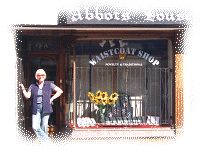
The Waistcoat Shop, Benedict Street

Lively streets
A new community
Glastonbury's legends and its reputation as a sacred site and a place of healing has led to its becoming well-known internationally. This started in the 1960s-70s when its mystical lore drew increasing interest as a result of the consciousness-shift of the time. One strong influence has been the late Marion Zimmer Bradley's book The Mists of Avalon. This reputation has drawn many people to live in the town – people who have joined the growing alternative community.
This community honours the sacred in a multitude of ways. It is probably the largest such community in England and is also probably unique in the number of beliefs and faiths represented (though places such as Totnes, Hebden Bridge, Stroud and the Findhorn area are comparable). Virtually every recognised spiritual path has its followers including Christians, Buddhists, pagans, Sufis, Druids, Hindus, magicians, native Americans, spiritualists and followers of the Goddess. In addition there are many people following their own individual, eclectic, self-originated path that is not necessarily aligned with any established or recognised religion, creed or belief. Glastonbury has a high proportion of national leaders in this field.
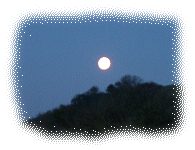
Fullmoon over Wearyall Hill
The new pilgrims
Glastonbury's growing reputation as a special place is now drawing an increasing number of visitors. Not all these are conventional tourists. Many are people for whom Glastonbury is seen as one of the great sacred sites of the world. These people come here on a spiritual quest and they are the new pilgrims. These pilgrims are drawn by the myths, legends, spiritual energies and people here – they are interested in what the alternative community has to offer and need the local shops, centres and and facilities, but they are not particularly interested in conventional tourist attractions. Many are from overseas – particularly Europe, Australia and America. These pilgrims are of many types but externally do not necessarily look much different to any other visitor.
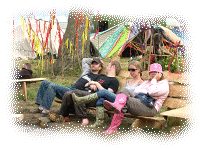
Glastonbury Festival
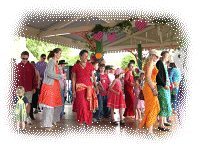
Mean Feet dance event
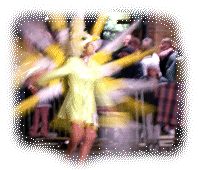
Glastonbury Carnival
3. New activity
So there is emerging in Glastonbury a new economy that runs beside the conventional economy. The newcomers have set up shops, healing and teaching centres, cafes and specialist B&Bs. They offer all kinds of therapy, training courses, specialist events, seminars and conferences. In the town centre fully a half of the shops cater for the alternative and pilgrim market – and the town now has many bookshops dedicated to this growing market. These new facets of the local economy are running beside the established and more conventional shops and services.
The combined effort could be thought of as a rebirth of the spirit of Glastonbury. There are no longer Benedictine monks but instead a wide variety of people recreating the spiritual heart of Glastonbury, but this time in a manner appropriate to the dawning of the 21st Century. This diffuse spiritual heart is supported, as before, by a town supplying all the needs of visiting pilgrims. Pilgrim visitors themselves are coming in increasing numbers bringing prosperity to the town just as they did in medieval times. So we see a rebirth of Glastonbury as great centre of international pilgrimage affecting the whole town. It is already happening and it will unquestionably accelerate as we progress into the currrent century.
4. Welcoming pilgrims
The pilgrim visitor wants most of the information that the ordinary tourist wants – B&Bs, maps, where to find things, but they tend to need these things in a specialised form. They want vegetarian and vegan B&Bs and cafes, places to meditate, places to 'just be'. They want to buy candles, incense, oils and esoteric books.
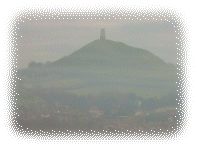
Misty Tor at dusk
They want to attune to the energies of Glastonbury and visit the sacred sites. They want to know where to find the White Spring and the Blood Spring, which they may not know is called the Chalice Well. They want to visit the ancient oaks Gog and Magog, Wearyall Hill, Chalice Hill, Bride's Mound and other sites not asked for by conventional tourists. They want to learn about and experience alternative methods of healing and ways of working and living that are spiritually, ecologically and humanitarianly sound. They want to meet people with special skills, they want to know what specialist alternative events are on and they want to know how to meet people with similar interests to their own.
Glastonbury has an excellent Tourist Information Centre – TIC – but as yet does not have a dedicated Pilgrim Reception Centre. The TIC and websites such as this remain the first port of call and can answer all the usual questions of accommodation etc. A team is being built up to support the TIC where the visitor is seeking something more unusual.
Glastonbury is an extraordinary and unique place. A growing number of the residents of the town are aware of this and will do everything possible to make your stay a truly transformative experience.
Isle of Avalon
This page designed Easter 2005 by Palden Jenkins. Pictures with many thanks to Lesley Delamont.