Magicians
We are back at the stone circle again, looking down on it from above. It's night-time: we can only just see the stones, as dull shadows in the moonlight. As our eyes adjust to the darkness, we begin to see that there are other shadows there, moving shadows that we slowly recognise are those of people dancing, weaving in and out and round the stones. Their shouts and cries and singing drift up to us through the night air; the sounds float upward, dancing themselves, as the people dance round the Dawns Myin, the Dancing Stones.
The dance grows wilder, the sounds sharper, shriller; but there is pattern and purpose there, even though it is hard to see quite what or where. And, imperceptibly at first, the glow, the energy-haze that we've seen before, begins to form: first as a thin mist trailing after each of the dancers, then thickening, spreading, till it forms a glowing ring rippling and moving round the dancers and the stones. The glow spreads inwards, rises, its colour changes; the brilliant ring of the dance now surrounds a pillar of electric-blue fire.
At an unseen, unheard signal the dance stops; the dancers and their glowing ring melt away into the night. All we can see is the pillar, its impossible flames licking round the circle of stones at its base. And from our vantage-point above we can see that the pillar itself is sinking, dispersing and spreading its energies underground along the water-lines and other energy-channels that centre on the circle – they all glow now with the same blue fire. The energy created by the ritual spreads the blue, the colour of healing, throughout the countryside that surrounds this ageless sacred site.
Tom Lethbridge once commented that all religious ritual is a form of magic; and it's in the study of sacred sites, the study of the major node-points of the natural energy-matrix, that we can see this most clearly. Stone circles and the like are real centres of power – in a number of senses, as we've seen – and that power can, with knowledge, be directed to an enormous range of uses. The direct physical use of the power, as power-magic, seems from traditional accounts to have been a particular speciality of the witch-cult, particularly in its later phases. One of the best-known stories concerns the destruction of the Spanish Armada in 1588 by a 'miraculous wind'.
In the version of the story that I've heard, all the Hampshire witches – a large number, according to all the accounts – met together on an unknown site to construct a 'cone of power' to send against the Spaniards. According to my magician friends, such a 'cone' would have looked not unlike the one in the image that heads this chapter. Once the cone was formed, so the story goes, the witches converted it into a violent but controllable gale that split up the Spanish fleet. What makes the story more credible is that the wind chased the fleet all the way up to the tip of Scotland, and then back down the Atlantic coast to Spain. Because of this endless storm, very little of the Armada returned intact to Spain.
It seems that as far as Queen Elizabeth was concerned, this storm did more damage to the Spanish fleet than did the harassment by her privateers, for a comment about 'this miraculous wind' has pride of place on a medallion she had struck to commemorate the occasion.[1] There's little doubt that Elizabeth's highly efficient secret police would have informed her of the activities of the witches, particularly if they were of a military or political nature, as this example of a very ' grey' piece of power-magic was. Assuming that the witches did create that 'miraculous wind', one rather wonders whether they created it from patriotism, or from hatred of the Spanish Inquisition, which would have persecuted them – to say the least – had the Spaniards won. With Catholic fanatics on one side, Puritan fanatics on the other, and with Elizabeth changing her mind about them by the hour, it can't have been easy for the witches to decide whom to support.
Now this is supposedly a story, not factual record, but it may well be true. Witches were traditionally credited with the ability to control the weather, and particularly to raise storms.[2] We do know that they were the last adherents of 'the old religion', which may well have been the remnants of a pre-Druidic religion; and we've already seen that a form of weather-control seems possible through the use of the artifacts of that religion, the standing stones, barrows and the like. All this adds credibility to the story.
We still don't know exactly how this storm-raising was done, but in many ways that's a good thing – for if the present-day military got hold of the technique, we wouldn't be able to see any of the sacred sites behind the barbed wire that they'd put up round them 'for security reasons'. It's bad enough already at Stonehenge on Midsummer Day: it's no joke trying to get into a suitable frame of mind for the dawn ritual when you're surrounded by searchlights, soldiers, police-dogs and triple-coiled barbed wire. From the activities of the State, the police and the military, anyone would think that the place and the rituals were security risks.[2a]

I suppose that in a way they are, for rituals do have real effects at sacred sites. Stonehenge itself can only be described as a mess – in every sense – and its 'atmosphere' is now almost beyond repair; but at other sites it is still possible to construct this sense of atmosphere consciously, and to project them into the place to act as filters on energies of various kinds that pass through the place. We've seen the unconscious versions of these as the ghouls of the last chapter – and remember that there are ghouls of joy and pleasure as well as those of fear, misnomer though this may be. But here, with rituals at sacred sites, we are dealing with the deliberate construction of a sort of super-ghoul' which affects not just people on the site, but also much of the surrounding area, because sacred sites act as centres or 'distribution points for occult forces', as John Richards put it.
According to tradition, it's not just people that rituals affect: many, if not most, of the old pagan rituals are to do with fertility of the crops and stock, the control of the weather, and the general health of the land. We have to remember that pagan cultures were not just 'close to the land', they were part of it; and we know that they believed that their health and their lives depended on the carrying out of a ceaseless round of rituals, some of which were carried out just anywhere in the fields, but others of which were carried out specifically at the sacred sites.[3] That belief is easy to laugh at, from our unnatural urban viewpoint, but the evidence we're collecting now suggests that, in some ways at least, the old pagans may not have been wrong.
Physically speaking, a ritual can have no direct effect at all. But this does not mean that rituals have no effects: even at the social level, one of the few which current academia admits, rituals are recognised to tie a community together and give it meaning and purpose. The energies that rituals create and manipulate are not in themselves physical, but they are made real in a physical sense by the way in which they affect people's attitudes, and thus their actions. There is considerable evidence that they can affect the general health of people, of animals and of plants by a sort of multi-level catalysis – but we'll come to that later. For now, the simplest way to understand ritual is to say that people literally 'real-ise' the energies that rituals create, in the sense that those energies become real through people. The energy behind a place-memory, for example, has no physical existence and no physical effect until it is realised through the mind of some person, or perhaps some other animal.
The various types of ritual seem to bear this out, in that they are as much designed to work on people's minds, and their attitudes to a situation or place, as they are to work on the place itself. One example of this was the exorcism service that was held in the Southampton flat of a school-friend of mine, when he was a student at the University there. The flat, which he shared with some fellow students, became haunted for no apparent reason, partly by strange noises, but mainly by an excessive sense of cold in one room, which refused to warm up even in summer.
My friend, a staunch Catholic, discussed this with the local priest, who agreed to hold an exorcism service there on the condition that all the members of the household were to be present. This was done, and from that time on there was no more haunting in the flat, at least as far as the people who had been present at the service were concerned. The odd thing was that casual visitors to the house could still hear the strange noises of the haunting, and could still feel the excessive cold of that room. The energies involved could only become real, in an experiential sense if not a physical one, through people who had been 'primed' to allow them to become real – or rather, in this case, through people who had not been primed to not let them become real. Rituals change the personal definition of what reality is, or should be, and thus help to make that subjective reality real in the physical world.
The same applies to rituals like, for example, the fertility rituals connected with dancing round the Maypole. I'd agree that the present day version of dancing the Maypole - small kids on the village green dithering round a gaudily-painted bit of stick – is almost meaningless, even if it is pretty; but four centuries ago it was still a matter that was taken seriously in Britain. The Puritan propagandist Philip Stubbes could, with evident disgust, still write this contemporary report in 1583:
'Against May, Whitsonday, or other time, all the yung men and maides, olde men and wives, run gadding to the woods, groves, hils and mountains, where they spend all the night in plesant pastimes; and in the morning they return, bringing with them birch and branches of trees, to deck their assembly withal ... They have twentie or fortie yoke of oxen, every oxe having a sweet nose-gay of flouers placed on the tip of his hornes, and these oxen drawe home this May-pole (this stinkyng ydol, rather), which is covered all over with floures and hearbs, bound round about with strings, from the top to the bottome, and sometime painted with variable colours, with two or three hundred men, women and children following it with great devotion. And thus beeing reared up ... they straw the ground round about ... and then fall they to daunce about it, like as the heathen people did at the dedication of the Idols, whereof this is a perfect pattern, or rather the thing itself. I have heard it credibly reported ... that of fortie, threescore, or a hundred maids going to the wood over night, there have scaresly the third part of them returned home againe undefiled.'[4]
It is in that last sentence that Stubbes reveals not only the righteous indignation of the civilised man (or is it, I wonder, just common envy?), but also the fact that he has completely missed the point of the ritual. The 'defiling' – as he calls it – of the maidens (and for that matter of the 'yung men' who were with them) was not disgusting licentiousness, as Stubbes implies, but a necessary part of the devotion, a religious act. The whole is a fertility ritual; and the energy produced by dancing round the Maypole – a still-living 'needle of wood', in the terms of our earth-acupuncture – has first to be primed to work towards fertility of the area. The energy is primed and directed by the state of mind of the participants in the dancing: and what better way of framing a 'fertility' state of mind could there be than spending the night in the woods, engaged in 'plesant pastimes'?
Fertility rituals aren't the only ones in pagan religion, they're just part of a complex cycle of religious events. Fertility comes into many of them, of course, but that's not surprising when we remember that people's lives depended on it. In the neo-pagan cycle of the presentday Druid Order, for example, the 'Earth Mother' character Ceridwen is symbolised by a maiden at the Spring equinox, a young woman (preferably pregnant) at Midsummer, and a mature woman bearing the fruits of the harvest at the Autumn equinox. From what I've seen of these rituals, their symbolism affects the 'colouring' of the energy stored at the place. It's possible that the different colourings of the energy left behind after each festival might prime the weather-control system in different ways: I'm not sure about this, but it does seem to make sense in Reich's terms at least.
The same is probably true of the old Celtic fire-festivals. These were Imbolc (February 1), Beltane (May Eve), Lugnasadh (August 1) and Samhain (November Eve). These festivals all seem to have involved the lighting of bonfires, and one of them is still followed in Britain, now thinly disguised as the 'Guy Fawkes Night' of November 5. It's interesting to see how these key festivals became Christianised: Imbolc, the feast of the Earth-Mother Brighid, symbolising purification of the earth, became Candlemas, the festival of the Purification of the Virgin Mary; while Lugnasadh, the harvest festival, became the Christian Lammas, a word which is apparently derived from 'loaf-mas', implying a feast of the harvest. The other festivals seem to have given the Christians more trouble, for their festivals follow the Celtic ones: All Hallows, a sort of general thanksgiving, follows Samhain on November 1, while the inconspicuous feast of St Philip and St James follows Beltane on May Day itself.
Beltane and Samhain were the pivot-points of the Celtic year, marking times of high instability. The material world seems to have been unstable at Beltane, bringing with it diseases and civil disorder: hence, perhaps, the practice of driving sheep through the bonfire at Beltane (purification by the equivalent of moxibustion, or a 'needle of fire', in our earth-acupuncture); and hence also, perhaps, the reason why May Day is now taken as a symbol of a day of bloodshed and revolution. Samhain seems to have been a time of instability in the spiritual world, when the fairy-mounds opened, when witches and warlocks were abroad, when the living and the dead could speak together, and when great good as well as great evil could be done. The sacred sites – of all kinds, it seems – were supposed to have been particularly active at these two times, and rituals held there then were believed to have a strong influence on events in the following half-year. If our hypothesis of a 'super-ghoul' effect is correct, it's likely that such beliefs were based on practical experience, not 'mere superstition'.
It seems that very few pagan festivals were not continued in a Christian guise. According to the Venerable Bede, at least, the Church in its early days in Britain had a deliberate policy not only of taking over existing sites – 'purifying them of devil-worship' first, of course – but also of disguising previous festivals as saints' or martyrs' days.[5] In some cases the entire rituals remained unchanged except for some details of names and terms.[6] Their meaning, and thus the priming effect of the rituals on the energies at the place, remained unchanged. The rituals gave meaning to a pagan way of life; and it was not so much the Church's suppression of paganism, but rather the increasing enforcement of a 'civilised' way of life on the whole of the countryside, that destroyed that meaning.[7] The result is the meaninglessness of life that we suffer today.
Be that as it may, rituals do still have real effects at sacred sites and others. On a Midsummer morning at Rollright, a few years back, it was discovered that some group had held an unpleasant ceremony the previous night, for beside the smouldering ashes of a bonfire were the dismembered remains of a very young puppy. There was no doubt that it had been sacrificed, and probably while alive. The atmosphere in and around the circle could be aptly described as hellish; and even though the owner had an exorcism service held there within a couple of days, an unpleasant 'buzz' – that's the only way I can describe it – could still be felt around the centre of the circle for nearly two years. As the Exorcism Report put it, "the activity of magicians frequently revivifies ancient celtic sites such as ... circles ... and causes a general sense of 'buzz' or strain which can be disturbing, if rarely dangerous." There's no doubt whatsoever that that ritual had a real effect in an experiential sense at least.
In this case the ritual – and I suppose also the nausea of the people who had to clear away the remnants of what the 'celebrants' had left behind – created a ghoul powerful enough to burn right through the 'white paint' of an exorcism service: it really was a 'super-ghoul'. With the amount of magical attention that Rollright has to put up with, it's not surprising that its atmosphere is best described as 'moody'.
But what of the effect of that ritual on the surrounding area? We know that Lethbridge's earth-fields act as stores for the coded energy that is behind place-memory ghosts and ghouls, and we know of the connection between those earth-fields and underground water, or at least water trapped in the soil as 'water of crystallisation'. We know too that the naiad- and dryad-fields at least are likely to be on water-lines. But we also know, from the work of Underwood and the other dowsers, that sacred sites are centres where many water-lines coincide with each other and with centres of overground patterns. We could therefore suggest that sacred sites are the centres which connect up all the earth-fields of a given area, and at the same time connect them with the overgrounds of the ley-system.
If this is so, activation of the central site, either by ritual on that site or through 'messages' coming through the overground network, could affect the attitude (so to speak) of the earth-fields of the entire area. Whether it would do so electrostatically, orgonomically, through the peculiar properties of water itself in the water-lines, by a combination of these, or by some other means entirely, I do not know: but whatever the actual mechanism involved, the idea makes sense, as far as we can make out at the present time. It does seem to be what is implied in John Richards' comment that 'the proximity of ancient sites may be the only explanation of places of disturbance which are not centred on a home', and that 'such centres act as distribution points for occult forces ... which appear to run on power lines or "leys" between each centre'.
But here, as you can see, we run into a certain amount of confusion as to the relative roles of the underground and overground connections between sites, for both types of connection do carry a wide range of energies or codings. Assuming that the term 'ley' does mean the same to Richards as it does to us, what he is describing is not so much the local distribution of energies, covering the immediately surrounding area, as the interconnection of the centres which feed each area. The two networks have slightly different functions.
To return to our earlier 'energy as paint' analogy, the ley-lines or overgrounds are like paint-carrying pipes linking together a network of spray-heads – the sacred sites themselves. The water-lines coming away from each centre, each sacred site, are like the paths which the paint takes travelling between the spray-head and the surface it is to colour; and the earth-fields, the naiad- and dryad-fields, are like concentrations of paint, small areas where for some reason or other the central part of each stream of paint from the spray-head will land. And although the surface is unevenly painted, every part of the surface 'beneath' the spray-head should receive some paint under normal conditions. It's possible, though, that some areas, because of blockages at the spray-head or elsewhere, or because of shielding or shadowing, or some other reason, might remain unpainted, however much paint may land elsewhere.
Assuming that the paint is at first just a colourless medium, it can be coloured, by the addition of pigment, at a number of stages. It may already be coloured in the pipe, in which case the same colour will be supplied to every spray-head. It may have pigment added at individual spray-heads, in which case the colouring at each may be different; and according to the way in which the pigment is added at the spray-head, it may or may not affect the colouring of that paint-medium in the pipe that is travelling through or past that spray-head to others. There may already be some colour on the ground-surface as small local 'atmospheres', or at the concentration-points (ghouls, in other words), which may have been put there by other means – by hand, we might say in this analogy – and this would provide interesting problems of colour-mixing, much as we saw before when we looked at the earlier version of this analogy as 'emotion as paint on the wall'.
The spray-head could be regarded as an active or passive filter, by adding or subtracting colour respectively. There is also another way in which it could filter colour, or other properties of the paint-medium, and that is by using differing sizes of filter-mesh to separate different sizes of particles. There could be different-sized meshes at different spray-heads, or even in different parts of the same sprayhead. If the pigment in the paint coming through the pipe were made up of several different colours, each of a different particle-size, they could be separated from each other by the different-sized filter-meshes; or, to twist the analogy a little, assuming that the paint started as a single pigment, this filtering could be used to alter the texture of the final painted surface, some areas thus having a smooth finish, others a rough one, yet others a mottled finish, and so on. The spray-heads could be made to filter a number of properties in this way, of which colour would only be one.
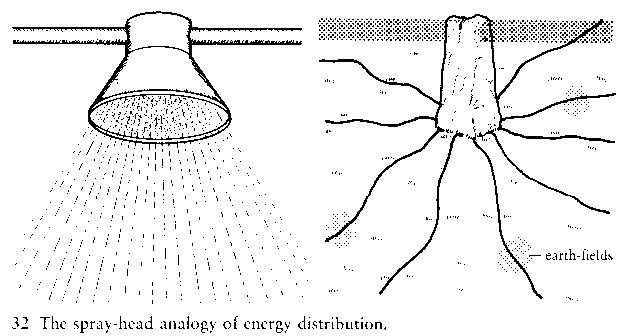
Taking this as an analogy, we can see that the overground and underground energy networks do carry the same energies, or properties, or whatever you want to call them, but the two networks carry them in different ways. The basic carrier in each case – water with the water-lines, God only knows what with the overgrounds – is basically neutral: it's just raw energy, a carrier like a colourless paint medium. This carrier carries the various properties in it, through it, by it – 'piggyback', if you like – and these properties can be added, subtracted, modified, interconverted at any point, from the basic transmission through the overgrounds down to the local level of 'atmosphere'. And this, as I said earlier, presents interesting problems of colour-mixing.
The problem in geomancy, then, is to balance all the different 'colours', 'textures' and the like – many of which will be changing by themselves all the time – in a way that produces a harmony, a music, at all the levels from local to area to national to international and, we might hope, beyond. That would be the ideal, but we haven't a hope in hell of doing it now, or at least not until we have a better understanding not only of geomancy but of ourselves as well – for we are ourselves a key part of that geomancy.
But we may as well start somewhere, and one place to start would be to clear up a few misconceptions. I hope I've cleared away a few already; but another I'd better despatch is the idea that at sacred sites all is sweetness and light. It's true that at some of them there is a tendency that way, but I think it's safer, and more accurate, to describe sacred sites simply as power-points. They are distribution points for various energies, places that collect those energies from the overground network. Assuming a good connection between upstairs and downstairs at any given site, we can say that, crudely speaking, high ley-line density at a site will give high energy levels at that site.
But note that this is probably going to be raw energy, the colourless paint-medium in our analogy: there is no reason at all why it must be the imaginary colour of all-sweetness-and-light. As Richards says, it is probably 'an instinctive awareness' of the energy potential of sites that leads to 'the willingness (of young people) to spend hours at such sites as Glastonbury Tor', but there needs to be an awareness of the energy for what it is, not what people would like to assume it is. Until that 'instinctive awareness' of young people at Glastonbury developed into something more than a bemused, naive and often arrogant instinct, those same energies made life pretty hellish there at times – as you'll remember if you'd been there during the 'No Hippies Served' seasons of the early 1970s.[7a]
Even if it is supposed to be the country's most important magical area, Glastonbury is in most other ways a very ordinary West Country town. So it's not at all surprising that there should have been clashes then between some of the townspeople and the hordes of spiritual sensation-seekers who invaded the town at the time. Even if the over-reaction of a few of the townspeople was unpleasant – it included the dumping of tons of caustic sludge around the caravans of those 'hippy invaders' who tried to stay in the area – the arrogance and tactlessness of the newcomers and the high energy levels of the area made it only too predictable. But at the same time many of these 'invaders' met with extraordinary and often undeserved kindness and tolerance from others of the townspeople: the energies will work in whatever direction they are asked to go.
High energy levels at a place like Glastonbury can make the whole area surrounding it unstable, at an emotional level and beyond. So while it's true that those energies can indeed create a state of 'all sweetness and light', they have to be pushed and held there, cherished with care and respect. If the area's atmosphere gets out of control, as it undoubtedly did in that case, those same energies are far more likely to turn themselves towards reinforcing someone's private hell.
Glastonbury is a quiet and pleasant place now: those of the 'invaders' who stayed have learnt the importance of tact, and respect for the people of the place as well as for the place itself. Most of the 'No Hippies Served' signs have gone. I often pass through the town on my travels, for business as well as personal interest, and the Tor with its weird, impossible tower seems to hold a fascination for me; but unless I'm there solely for business I can't stay there long. It is perfectly possible to live an ordinary life in the areas around the great sacred sites, you don't have to be a saint to live there – and that's something which few of those 'invaders' of Glastonbury realised. The problems onlystart when you turn your attention towards those energies, for then (as John Cowper Powys put it in his epic Glastonbury Romance) the 'invisible Watchers above the town' start to turn their attention toward you. At least part of those 'Watchers' is yourself: you have to bring to the place what you would wish to find there. The problem is the same as with the atmosphere of a house, but far, far more so in this case.
This, of course, is the whole point of a pilgrimage, in that you have to purify yourself before you get to the holy place. The time spent in travelling to the place must be a period of contemplation and preparation, or else you just won't be able to handle what will be thrown at you by the place. In a personal sense, sacred sites can be mirrors that pick out your flaws, amplify them, and then throw them back at you in a way that forces you to do something about those flaws or go insane. It's happened to me at several sites, and it's not a comfortable experience; the ordinary people of places like Glastonbury, I imagine, stay sane only by being thoroughly civilised, ignoring the existence of those forces as hard as they can. Since I live in a city, I have to spend several days in the country before I can quieten down enough to handle the sheer power of the great sacred sites; and that is why I can't stay for long in places like Glastonbury, if I'm only passing through.[7b]
A pilgrimage, then, is as much a magical process as a religious one. You could say that it is the use of a religious mode to prime the energies at the place in order to cause a magical transformation – sometimes a physical transformation of healing, as at the holy wells, but more often a transformation of the soul, of one's attitude to the world. If that priming isn't done, the pilgrimage may be useless, or even harmful. To return to our 'paint' analogy, that kind of priming affects the colour and texture – and whatever else - of the paint only in relation to you; it selects the final properties of the energies, in other words, at the point where they reach you.
This assumes, though, that the paint is initially a colourless medium, right up until that point of contact; and as we have seen, there are a whole range of points at which the properties of the paint can be changed in its travels from wherever it comes from – which we don't know – to that final point of contact. It can be changed at the sacred site or power-point – the spray-head in the analogy – by ritual or by some other conscious or unconscious means of changing the atmosphere of the place; and it can also be changed in the 'pipe', within the overground network itself. If the place is to work as a place of healing (or, literally, 'wholing') both for people at the place and for the area surrounding it, all those properties must harmonise with each other. If they don't, the resultant discord will, it seems, produce dis-ease. Some of the factors which produce discord are beyond our control – though not entirely beyond our direction – since they are, as the Exorcism Report puts it, 'non-human'; but all the human factors are, or can and should be, within our control. We've looked at quite a few of these human factors so far, but there are still a few others we need to look at before we go on to look at the non-human aspects. And these new human factors are particularly important, for they operate on the energies as or even before they arrive at the power-points.
The one major category of magical operation on the power-points themselves that we haven't yet looked at is that rather odd category in the Exorcism Report, 'human sin'. As the Report put it: 'a house or site used for sexual misbehaviour (often the ancient fertility-cult site), but equally the office of an organisation devoted to greed or domination, can often incur trouble or act as a dispersal centre'. I think we need to regard that comment about 'sexual misbehaviour' as slightly suspect, as the Church's definition of 'proper' sexual behaviour is still a little limited; but there's no doubt that fertility rituals can be dangerous in some respects. To use the paint analogy again, we could say that the colour of fertility rituals is an odd one, and has to be balanced carefully by others. Fertility rituals, in other words, must be only a part of a more complete system of rituals.
If fertility rituals do actually stimulate the fertility of the land, we can see that over-stimulation – as would be the case where fertility rituals were used to excess - would cause as many problems as under-stimulation. When fertility rites are taken totally to excess, as they are in Crowley-style sex-magic, the Commission on Exorcism is probably right to suggest that 'human sin' of this kind 'opens the door for other forces to enter in'. I'm not sure exactly what those forces would be, and I'm not sure that I want to know: for in the cases that I've heard of it would be appropriate to describe them simply as 'hellish'.
This leaves us with that extraordinary comment that 'the office of an organisation devoted to greed or domination may incur trouble or act as a dispersal centre'. The social and political implications of this throwaway comment are, to say the least, staggering, and I'll be going into them in some detail later. For now I'll just say that it completes the range of effects of attitudes of mind of people living, working and acting upon power-points and lesser sites, by adding moral and ethical factors to the emotional and similar ones we've already met. Greed and the wish to dominate are attitudes of mind and being, and these, as we've seen from all our studies of hauntings so far, affect the places where those attitudes are held. A negative or destructive attitude will cause a negative or destructive effect.
This is true anywhere, affecting the atmosphere of the place; it is more serious at Lethbridge's earth-fields, for then a true negative ghoul would be formed; and it is particularly serious at power-points, for the 'colour' supplied to the whole area would be affected. In magical terms, as we have seen, simply being at a place is enough to implant that attitude into the place, if the other conditions make the site receptive; so in magical terms we can say that people who devote themselves to greed or domination, or particularly organisations which devote themselves to those aims – which could be said of a large number of our present-day organisations and institutions – are practising a form of black magic which is a danger to us all. I don't care whether it is done consciously or unconsciously, it is still magic; and in magical terms it is unquestionably 'black'.
The implications of that, as I say, will have to be left for later. But there is another type of 'activation of ancient celtic sites by magicians' which does seem to be important in any study of hauntings. even though it doesn't seem to affect the 'colouring' of the energies: and that is the creation and activation of what my magician friends call 'guardians'. Fortunately these are rare, for the various reports I've had of them suggests that they can be extremely dangerous. Basically, they are images which at first seem to be ordinary place-memories stored in a place, or in some cases in an object. They do resemble place-memories in that respect: but there the similarity ends. As far as I can decipher from the reports, they are not impersonal memories, like the place-memory ghosts, but rather the storage of a protective function or idea – yet an idea that is active, in that it has a limited amount of choice and intelligence both in the choice of form in which it appears and the movements and effects it can have.
Unlike place-memories, which are planted into the place unconsciously, these guardians are implanted into the place or object by some deliberate process. They are then, like place-memories, left to be activated by anyone who happens to fulfil certain conditions, such as, in the case of a barrow-guardian, breaking open, and thus 'short-circuiting', the barrow. It may be that a fair number of the legends of 'divine retribution' against barrow-robbers and the like are due to these elemental guardians: no matter how crazy it may sound, these all-too-active images do have a real force, and are not to be taken lightly.
One well-known recent example of an active guardian was that of the Hexham Heads, a pair of Celtic carved stone heads that had a werewolf-like figure associated with them; there is little doubt from the full report that this image was too active, too free and too physical in its movements and effects to be a place-memory ghost.[8] What is interesting is that although the two heads were removed from the house as soon as the connection between them and the figure was recognised, the hauntings continued. Dr Anne Ross, the archaeologist in whose home the majority of the hauntings took place, called in the Hampshire exorcist, and he advised her to dispose of her entire collection of more than twenty of these carved heads, because the two original heads had somehow activated them enough to be able to sustain the haunting by the guardian from the original heads. It was only after all the heads were removed that the hauntings ceased. This incident is doubly interesting to researchers on our 'lunatic fringe of archaeology', in that it's one of the rare instances of a professional archaeologist publicly describing a subjective experience of this kind.
Another incident, closer to our current theme of sacred sites, concerns the 'guardian' of a barrow. I came across this case because a friend of mine, then a psychiatric social worker, had to deal with its aftermath. It happened a few years back. The incident began when a group of students found or bought an old book of gramarie: a book of spells, if you like. For a joke – as they thought – they decided to hold a conjuration on top of a barrow at night, 'just to see what happened'. Something did. My friend wasn't able to get a precise description from the students of what suddenly appeared on top of the barrow, since its appearance was slightly different for each of them. (This is a characteristic of guardians and many other kinds of 'thought-forms', as we shall see later.) As one of them put it, it was like a horror-movie monster, but it seemed to them to be very real, and right in front of them. Not surprisingly, they panicked and scattered; but for several days afterward they were haunted by the fear that it was stalking them, and might appear at any moment, even when they were back in the city. My friend had to talk them out of their fear, and thus protect them from further haunting. In some ways this incident is reminiscent of M.R. James' ghost story Oh Whistle and I'll Come To You, My Lad; but I think it does show that magical rituals, even if only performed in jest, will still work if the right conditions are fulfilled.
Dangerous as they might be, these guardians don't have much effect on the colouring of the energies passing through sites like barrows. They have much the same relationship to that colouring as an alsatian guard-dog has to the product of the factory it guards, and - so I'm told – about the same level of persistence and intelligence. So with these we leave the sites themselves, and turn to the transmission of energies to the sites through the ley-system, the overground network.
But first we'd better look at the transmission of energies in general. The concept of colouring or texturing of the energy assumes, first, that there is an energy to be coloured, and second, that the energy is capable of carrying colouring or some other coded information of a high degree of complexity. On the first point, I have no doubt whatsoever of the existence of some kind of energy associated with sacred sites, as my being knocked flat by the release of the 'spin' at Rollright made only too clear. Even if the energies themselves are subjective, they have been experienced by enough people for them to be called objective in one sense at least. The distribution and channeling of those energies in pathways both above ground and below seems to have been established, at least from the results of a fair number of dowsers; but the ability of these channels to carry coded information of any degree of complexity had not been so well established. Following some clues given me by various dowser friends, I set up a series of experiments on this; and the results do show that these channels are capable of carrying coded information up to the complexity of Morse Code at least.
My experiments started when two dowser friends from Wales pointed out that if one dowser stands on a water-line, holding a pendulum in neutral oscillation, that pendulum will react when another working dowser crosses the same water-line. Following their suggestion, I found a suitable testing-ground where a water-line passed under a wall close to a door, allowing us to place a dowser on either side of the wall, with an observer able to watch both dowsers by standing in the doorway. The two dowsers took turns to be transmitter and receiver, to see if there was any difference between transmission upstream and downstream. I suppose we took the theory to be that the transmitter interfered with some kind of tuned circuit inherent in the water-line, and it was this interference which the receiver recognised as the signal; I'm not sure now, we changed the theory so much as we went along. The point was that it worked.
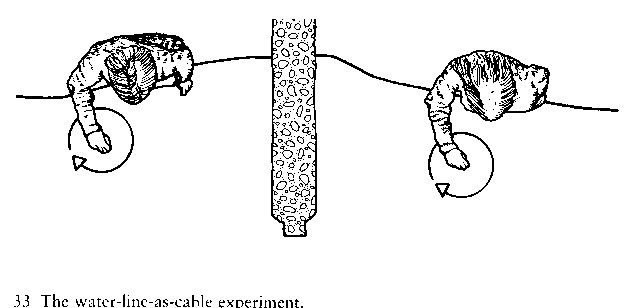
The results were interesting. First, we found that the pendulum was definitely the best type of dowsing instrument for the job, as all the others we tried required the receiver to be moving about, in order to break their starting friction. In the technique we used, the pendulum's 'neutral' position is one of constant oscillation, and so it doesn't have that problem. Second, we found that it was a little easier to get reliable results if the receiver was downstream of the transmitter, but we could still transmit both ways without too much difficulty. And third, a lot depended on the skill and continuous concentration of both dowsers, which I admit didn't surprise us much. The most serious problem in this was certainly that of concentration, for if either dowser allowed it to lapse for more than a moment the receiver's reactions went 'out of phase', with the pendulum reacting when the transmitter walked off the water-line instead of when he walked onto it. But the results seemed to show that, with practice and with skilled dowsers, this technique could be used with water-lines to work a crude but effective medium-range Morse-Code-type communications system.
Later, when we were experimenting with multi-way communications of this type, attempting to transmit between several dowsers on the same water-line, we came across a simpler technique. Instead of having the transmitter building up the Morse-Code pattern by walking on and off the line, all the dowsers involved in the communication stood still directly above the same water-line. The receiver or receivers held their pendulums in neutral oscillation, as before; but this time the transmitter swung his pendulum in gyration, simulating a reaction. This gyration repeated itself in the receivers' pendulums. This system demanded even more concentration than the earlier one, particularly to keep the reactions and 'neutrals' in phase; but it also allowed us to use a more sophisticated and reliable set of reactions for the Morse-Code pattern, using a clockwise gyration for 'dot', an anticlockwise gyration for 'dash', and the neutral oscillation for the spaces.
Up to this point we'd only done these experiments with water-lines; but in experiments at Rollright we found that we could use the same technique with the overgrounds. We first tested this with a very short section – only a couple of yards – of the 'spin' overground at the eastern gate. When these tests were successful we tried it with two of the major stones (stones 3 and 37 on the official site-plan), about a hundred feet apart on opposite sites of the circle, which I knew from my earlier work were connected by an internal overground, probably a fourth-band one. Two of my students found that for them it was actually easier to get reliable results from the overgrounds than from the water-lines. Neither of them had done more than a few hours' practical dowsing before that time, but on a cold November day they kept transmission and reception accurately in phase through a short test-run of about a dozen changes of gyration. Towards the end of that run, it seemed that the receiver reacted more to the transmitter's intention to gyrate her pendulum rather than the actual movement, as she picked up the correct reaction about half a second before the transmitter's pendulum gyrated in the relevant direction. This suggests that the coding of the energy in the overground in this case was more mental than physical; and in turn this implies that the overgrounds at least are indeed capable of carrying coded information of the complexity of the 'colour' and 'texture' that seem to be involved in the various 'earth mysteries'.
So far we've only tried these experiments with short- to medium-distance communications - no more than a few hundred yards – as we haven't been able to borrow the transceivers or field-telephones we'd need to do running checks on the results; but I have little doubt that longer-distance communications based on these techniques would be possible. Assuming that the dowsers involved were skilled and well-practised, the main problem would seem to be that natural pulsings of the energies in the lines, both above and below ground, would produce a background noise that could obscure the transmitted signal at times. But this is a problem that dogs more physical communication-systems like short-wave radio – and as with short-wave radio we could no doubt devise noise-reducing systems to get over it.
If we take the original cable-type telegraphy as an analogy for the kind of communications described above, we can see that the same cables were used later to carry teleprinter messages, telephone messages and 'wired' pictures by using more complex codings and modulations of the same energy in the cable. So by analogy we can at least suggest that although my experiments dealt only with a crude Morse-type code, there is no reason why the same 'cables' should not carry more complex codings. As the results from the Rollright experiments suggest, these may be codings not just of physical energies, but of other levels of energies as well. No matter how little sense that makes in physical terms, it does make sense in terms of the research we've seen so far.
The emotional 'colour and texture' codings that seems to be responsible for the hauntings we've looked at are probably not the only kind of non-physical coding that the overgrounds and waterlines can carry. A number of my correspondents have told me that the transmission of complete mental images – telepathy, in other words – is much easier between sacred sites than elsewhere, and this seems to be borne out in some of my own experiments. Magician friends have told me that in their experience both forms of what they call 'astral travelling' – projection of the imagination and projection of the entire personality – are made easier by hitching a ride on the energy that passes along ley-lines or overgrounds; and Carlos Castaneda described in one of his books an incident in which his personality 'travelled' along water-courses, apparently for hundreds of miles, which suggests that water-lines could be used to assist astral travelling as well as the overgrounds.[9] The Feng-shui concept of spirit-paths, clearly-marked pathways on which the spirits of the dead travel, suggests that astral-travelling, as the projection of the personality, may not be limited solely to the personalities of the living.
Mention of Feng-shui brings me back to the problem of interference with the transmission or the coding of the energies passing through the energy-matrix. The nineteenth-century European writers on Feng-shui all commented on the way that the Westerners' rationalist exploitation of China was constantly hindered by Feng-shui 'superstition'. As Eitel put it, 'when it was proposed to erect a few telegraph poles, when the construction of a railway was urged upon the Chinese government, when a tramway was suggested to utilise the coal-mines of the interior, Chinese officials would invariably make a polite bow and declare the whole thing impossible on account of Feng-shui.' At first this just sounds like conservatism, a use of Feng-shui superstition to prevent or limit change, and indeed most of those writers on Feng-shui regarded it as such – but there is more to it than that.
A comment by Dukes helps us in this, for it is more explicit and more revealing: 'The first railway in China, from Shanghai to the port of Wu-Sung nine miles away, was purchased and destroyed by the Chinese on the plea that the speed of the train destroyed the Feng-shui of tens of thousands of people on both sides of the line'.[10] This doesn't appear to be simple conservatism, for the same Chinese authorities had allowed the line to be built in the first place; and it is stated specifically that it is the speed of the train that is causing problems. In other cases it is the straightness of the lines of telegraph poles, for example, that are said to damage the Feng-shui of an area. So the complaints are almost always about specific aspects of a development rather than the developments as such, and Feuchtwang cites cases where development had been permitted to take place on the proviso that care should be taken not to damage the Feng-shui of that area.[11]
We have seen earlier that a close parallel can be drawn between the apparent British system of geomancy and a combination of Chinese geomancy and acupuncture. To strengthen that parallel, evidence is now arising from a number of sources to suggest that many modern developments in Britain are having exactly the effect on the flow of natural energies in the energy-matrix that a combination of Feng-shui theory and acupuncture theory would predict – namely, a highly destructive one. Most of this evidence is coming out of dowsing work on a form of environmental medicine, which we'll be looking at in some detail later. Unfortunately, much of the information remains unpublished;[12] but from discussions I've had with a number of the dowsers involved a number of key points have come over. One of the most important of these is that most of the problems they have to deal with stem, as in acupuncture, from blockages and other disturbances in the energy-matrix; and most of these disturbances arise from man-made causes, not natural ones. Among the most common causes of these problems in recent times are motorways, pylon lines and mining and quarrying.
The effect of motorways is odd. The structure of the motorway itself probably doesn't do much damage, being the earth-acupuncture equivalent of a relatively minor scar. It seems to be the vehicles travelling along the motorway that cause the worst problems, for the energy in any overgrounds crossing the motorway and close to its surface catches on the vehicles as they go past. In the terms of our 'energy as paint' analogy, we could see the energy of the overground as a horizontal pipe or rod of luminous liquid crossing the road: and as each vehicle passes by, it breaks the stream of liquid, splashing the liquid over the road, the vehicle itself, everywhere, reducing the amount of liquid that can carry on, and introducing surges in the flow as it tries to even itself out on the other side of the road.
This is only one half of the problem, for as well as reducing the total amount of 'coloured' energy that arrives at its proper destination, this constant interruption by one vehicle after another would also break down any time-based coding in the energy-flow (a coding like a telegraph message, as opposed to something more constant like colour). The overall result, as you can imagine, would be a mess, but most of these problems with motorways can be alleviated if not solved. The usual solution is to divert the overground either under the motorway, or higher, or in a slightly different direction, by processes which we'll look at later. In most cases motorways aren't too bad – from an earth-acupuncture point of view – apart from their permanent scarring of the landscape. They do cause a lot of hidden problems, but those problems can usually be resolved without too much difficulty, and without affecting the effectiveness of the motorway as a mode of transport communications.
Unfortunately, we can't say the same about pylon lines. The two problems with these are their straightness (with occasional bends) and their height. As with motorways, the lower overgrounds 'catch' on them because of their height; but unlike motorways the interruption they cause is not intermittent but continuous, lasting as long as there is an energy-flow in the overground. Basically, pylon lines split the energy-flow, allowing part of it to continue on its way, but sending the remainder down the pylon line itself. The proportions 'stolen' by the pylons vary enormously, for no known reason. At each bend in the line of the cables some of the energy that originally ran down the overground spins off at a tangent, effectively forming a new low-powered overground. The result is that in some areas – like the area around Yarnley, just to the north of Glastonbury – the web of pylon lines, large and small, produces large numbers of 'unofficial' overgrounds, allowing energy of the wrong kind to arrive at the wrong place at the wrong time and probably from the wrong direction.
The result, in other words, is not just a mess, it's absolute chaos. In some cases and areas it may be possible to divert the major overgrounds upwards so that they are above the power lines; but in others the dowsers I talked to felt that the only satisfactory solution would be to put all electrical power cables underground. Even given the enormous cost of doing so, they reckoned that it would still be worthwhile in every sense to do so, because of the pylons' hidden effects on the health and fertility of the land.
Probably the more serious problems in this respect come from quarrying and mining, because of the near-permanence of their effects. For a start, an open-cast quarry could be said to be the equivalent of a massive scar or open wound, in acupuncture terms; and that means that such a quarry would prevent any energy in its immediate vicinity from passing through, either below or above ground. The same goes for spoil tips and slag-heaps: they are literally scars on the landscape. It's true that some of the blockages, particularly of overgrounds, can be reduced by 'massage', in the form of filling-in and grassing when the quarry or tip is no longer used as such; but the underground damage is permanent. Mining of any kind breaks up the sub-surface flow of water, and thus of energies: the deeper the mine, the deeper down goes the damage.
This affects not just our near-magical energy-system, but people's water-supply: one recent case the British Society of Dowsers had to deal with was where blasting – believed to have been done by the National Coal Board – had shaken up and re-fissured the sub-strata in a small area, with the result that all the wells in three villages went dry overnight. But it's not just the damage to the water-supply that concerns us: there is the energy aspect too. One stone circle I went to, at Dinnever Hill in north Cornwall, is now completely dead, both below ground and above, because all the water in the immediate area has been drained away into the vast china-clay works that starts a mere fifty yards away.
Damage of that kind to a previous power-point means that no energies can come into the point, or be distributed from it; energy that is already there cannot escape, and the whole area stagnates. In Feng-shui terms, the ch'i, the living energy, is converted to sha, stagnation, 'noxious breath', stinking exhalations'. Such an area cannot breathe, say the Feng-shui manuals, and ill-health and ill fortune will result. From what I saw of the area around Dinnever Hill, the Feng-shui manuals are right.
But it's no use complaining about this: the quarries, the pylons and the motorways are there, and that is that. And it's no use calling for a ban on all future development: in the present economic circumstances of the country, and with the present politico-economic system we live in and (in our various ways) support, that would be more than a little unrealistic. What we can do, and do need to do, is to learn to repair the damage that we cause, to learn how to reduce the impact of our grubbings and burrowings. To do that we need to know much more than we do about the energies and their interactions with nature, with places and with ourselves.
So far we've looked at the various ways in which we interact directly with the energies and with places. But there is another factor which we cannot ignore, no matter how ludicrous it may seem in a materialistic and humanistic age, and that is the non-human factor: forces outside of our control, impossible forces or entities which the Exorcism Report describes as 'the activities of non-human sprites' and 'demonic interference'. It seems that the forces which produce balance or imbalance of the energies in the natural energy-matrix, producing Feng-shui's ch'i and sha, are the same as those which are reflected in the Christian vision of the battles between the angels and demons - and they are thus important to our aim of a more complete understanding of nature.
Notes
[1] See Lethbridge, ESP, pp.111-12.
[2] See Frazer, The Golden Bough, pp.79-109; also Janet and Colin Bord, The Secret Country, p.57.
[2a] The State's handling of Stonehenge and its non-tourist visitors has never been good at any time since 1909, when it was given custodianship of the site 'in the name of the nation'; but in 1985 the situation nearly turned into warfare in an appalling piece of misuse of legal force without legal right on the State's part. In a move roughly equivalent to banning Christians from worshipping in St Paul's Cathedral at Christmas, an annual gathering of neo-pagans for the summer solstice at Stonehenge was banned, supposedly to prevent damage to the site; but the only damage, and an enormous amount of it, was done by police and soldiers in building barricades and ditches across every road in the area! An attempt to break the ban in a peaceful march resulted in a pitched battle with a highly dubious abuse of force by the police. Technically, as a result, it is doubtful whether English Heritage, the government department nominally in charge of Stonehenge, now has any legal rights to the site 'in the name of the nation', since it is in flagrant breach of all three conditions – right of access, price of access and non-alteration of the site – of the Deed of Gift of 1909: an interesting legal situation. This is discussed in detail in John Michell's pamphlet Stonehenge, June 1985.
[3] See Brian Branston, The Lost Gods of England, and George Ewart Evans, The Pattern Under The Plough, for some of the many examples.
[4] The full quote from Stubbe's Anatomie of Abuses, about twice as long as the version I have shown here, is in Frazer, The Golden Bough, p.162.
[5] The best-known example of this policy is expressed in the 'Mellitus letter' which Bede quotes in his Ecclesiastical History – see Brian Branston, The Lost Gods of England, pp.53-4 – but there are many others.
[6] One set of examples is the Christianised 'charms': see The Lost Gods of England, pp.48-51.
[7] George Ewart Evans describes this in detail in his books on East Anglian traditions, including The Pattern Under The Plough.
[7a] And sadly, the mid-1980s: Glastonbury caught the backlash of the Stonehenge fiasco of 1985, and re-started the same unpleasant handling of any visitors who didn't fit some shopkeepers' image of 'proper' people. At this time – early 1986 – the affair has settled down: but the mentality which created it remains intact, so no doubt it will re-surface again, and again, and again.
[7b] I moved to Street, near Glastonbury, in 1978, to run a print business there: but despite Glastonbury's fascination, I still can't stay in the town itself for long. Even on the edges of that infamous 'Glastonbury Zodiac', life in the backwash of its energy (and the chaos of its endless stream of self-appointed Messiahs) can be distinctly uncomfortable at times, as I have learnt to my cost. Life at sacred sites, in my experience, is definitely not one of all-sweetness-and-light!
[8] A summary of the incident can be found in the leader to Dr G.V. Robins' article Images in Stone in TLH 76, p.11.
[9] I know that Castaneda's books are now no longer believed to be his personal diaries; but they are known to have been derived from accurate sources in any case, so the incident was certainly valid as someone's experience even if not Castaneda's.
[10] This comment, cited in Feuchtwang, Chinese Geomancy, p.221, is from Dukes' article Feng Shui in Encyclopaedia of Religion and Ethics, Vol. V, published in Edinburgh in 1912.
[11] See Feutchtwang, Chinese Geomancy, pp.221-2.
[12] Some has been published in various issues of the British dowsing journals, such as JBSD and the Radionic Association Quarterly, particularly under headings like 'the control of noxious earth rays'.
Copyright © 1978-98 Tom Graves