
And did those feet in ancient time
Walk upon England's mountains green?
And was the Holy Lamb of God
On England's pleasant pastures seen?
And did the Countenance Divine
Shine forth upon our clouded hills?
And was Jerusalem builded here
Among those dark Satanic mills?
William Blake
Avalonian Mystery Traditions
Of Nazareth and Arimathaea
by Palden Jenkins
During the Middle Ages, Glastonbury Abbey was one of Europe's greater pilgrimage places, home of a large library and host to a succession of scholars. It was a place of learning drawing in more than scriptural and ecclesiastical studies. It had a special sanctity to it, overriding ecclesiastical doctrine and drawing to it freethinkers of all times. The Orthodox church still recognises Glastonbury as the primary church of the West, superior to Rome by dint of its Christian antiquity. This is because tradition has it that Jesus came here.
The tradition of Joseph of Arimathaea and Jesus (as a young man during the 'lost years') visiting Glastonbury, despite all the scepticism given it, seems quite sound to me [See The Fire and the Stones, Nicholas Hagger, Element, 1993, A Glastonbury Reader, John Matthews, Aquarian, 1991, A Quest for the Historical Jesus, Prof Fida M Hassnain, Gateway, 1993, and IsleofAvalon: History section]. He was a world teacher, not limited to Palestine, and his audience was not just Jews and Greeks. Many suggest that the Glastonbury Jesus tradition was a publicity stunt staged by medieval monks to raise money and favour after the Abbey fire, yet this in itself smacks of spurious debunking and medieval church politics emanating from Canterbury and metropolitan authorities more than evidential fact. Fact is, throughout the Middle Ages, the Catholic and later the Anglican church in Canterbury and its proxy, the bishopric of Bath and Wells, were jealous of Glastonbury's primacy and did their best to bring it down – at one time there was a serious hostile takeover attempt by Wells, which failed.
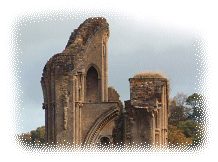
After the Crucifixion, Joseph, a metals trader and Essene, seemingly the financier of the Jesus operation, came to Glastonbury as a refugee with twelve acolytes, to found the first purpose-built church in Europe, possibly the world – since Christians of the time met quietly in cellars and kitchens, and didn't build temples until a later date. Joseph was, according to tradition, welcomed by the Druids of the time and allocated twelve 'hides' of land on which to build and support a wattle church and community. He died here. The Christian line faltered in the following decades and centuries, though it more or less survived until St Patrick came along in 433 to found a monastic community and set in motion the incremental development of the Abbey.
The Abbey was eventually fully endowed by the Saxon King Ine in 704 and, with the help of Patrick, Dunstan and other noble clerics, by Norman times in the 1100s it had become great and wealthy. Glastonbury Abbey stood separate from the rest of the Church in England since, embarrassingly for the Church, and particularly the bishop of Wells, it was older and England's 'holyest earthe'.
Even at the dissolution of the monasteries by Henry VIII and his men in the 1530s, Glastonbury was closed down a full two years after all of England's other abbeys and cloisters – and probably only because Abbot Whiting refused to yield up the sacred relics (phials of the blood and sweat of Christ on the Cross, plus possibly the chalice used in the Last Supper). These relics would have conclusively proven the primacy of the leader of the English church – by now the king himself, by his own self-appointment – over the Pope in Rome, which was a political move of considerable import akin to the British prime minister of today hijacking the whole European Union.
Isle of Avalon
This page written and designed in February 2006 by Palden Jenkins.