
Clash of civilisations? The Tor from Street bypass.
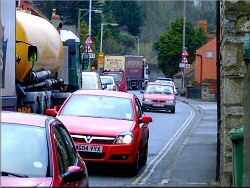
Pilgrim route Chilkwell Street, choked with traffic
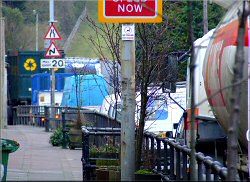
Vehicle drivers don't want to be there either
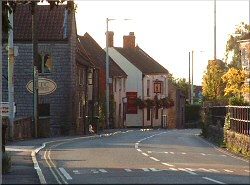
Chilkwell Street takes a welcome rest as a result of a car crash outside Glastonbury
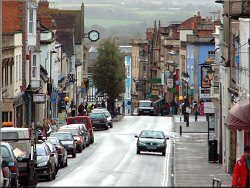
High Street on a quiet day - still lots of cars
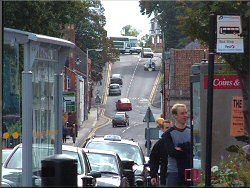
Magdalen Street and Fishers Hill
Local issues
Road Traffic
Glastonbury is very much affected by road traffic. Since the 1970s traffic has grown enormously as the number of vehicles has increased and the area has developed from a rural area into ex-urbia - a country area with an urbanised lifestyle.
Road-building and traffic management has not kept pace. In Glastonbury, heritage conservation areas and the old pilgrim route into Glastonbury, Chilkwell Street, are choked with cars and trucks. Local main roads have graduated into regional main arteries without being properly upgraded.
Glastonbury has half a relief road, taking the A39 from Wells to Bridgewater around the town. But the A361 from Frome to Taunton still comes into town, leading to tragi-comic instances of trucks squeezing through narrow gaps past 300 year old cottages, which are gradually being shaken to death.
This mayhem stops occasionally, either because of a crash outside town or near the Chalice Well, blocking the road, or because the road is occasionally closed for pilgrimages or road works. Things go quiet, and the air clears. Glastonbury's charm and mystique returns.
Glastonbury's residents and visitors are pressured by road traffic. Bere Lane is unpleasant for pedestrians and dangerous for cyclists. Sitting on the top of the Tor, traffic noise below pervades the air.
Most traffic is through-traffic, and Glastonbury simply lies in the way of drivers passing through. It's a problem for them too.
As a visitor centre and pilgrimage place, traffic is a plague. Visitors walking from the Abbey and High Street to the Tor must endure sometimes-gruelling traffic experiences. Locals walking down the High Street are squeezed between cars. Children cannot safely ride bicycles around town. Sometimes it can take minutes just to cross the road.
There have been plans and opportunities to have a full relief road since the early 1980s, but it has happened only partially. Part of the reason for this has come from government and planners (government at all levels is good at ignoring Glastonbury), and part comes from local people themselves - the community has been divided on the question of road traffic. Many locals like owning cars, and believe that removing through traffic will bring a loss of trade. In fact, improvements in the quality of the town environment would most likely increase trade. In the 1980s and 90s a curious alliance of change-blocking conservatives and greenies opposed to road-building resisted the building of a relief road, so it never happened.
Get this. If Glastonbury really wished to strengthen its local economy, it could become Britain's first totally traffic free town. It is of a very walkable size. If instituted gradually, with imaginative and proper measures taken to deal with parking and movement inside the town, difficulties could be ironed out, and benefits accrued would far outweigh problems (such as for the disabled, or for freight deliveries). This sounds like a fantasy, yet it can also be viewed as a regeneration project for the town.
Perhaps the traffic problem will be resolved only when transport levels decline overall, in connection with the looming oil crisis. Transport politics and economics of the last 50 years have favoured road traffic, but this is not permanent. Things will change.
Glastonbury is a place where subtle energies are strong and sensitised. Traffic, with its noise, pollution and perpetual and imposing activity, has a greater than normal suppressing effect on the town and its true reason for being. It could be that Glastonbury's understated purpose as a place of pilgrimage could flourish as traffic declines. Because travelling would become more meaningful and deliberate, and pilgrimage would again become significant as a life-activity.
Who knows? Times are changing. The traffic situation is unsatisfactory and destructive of our town. Something has to shift.